
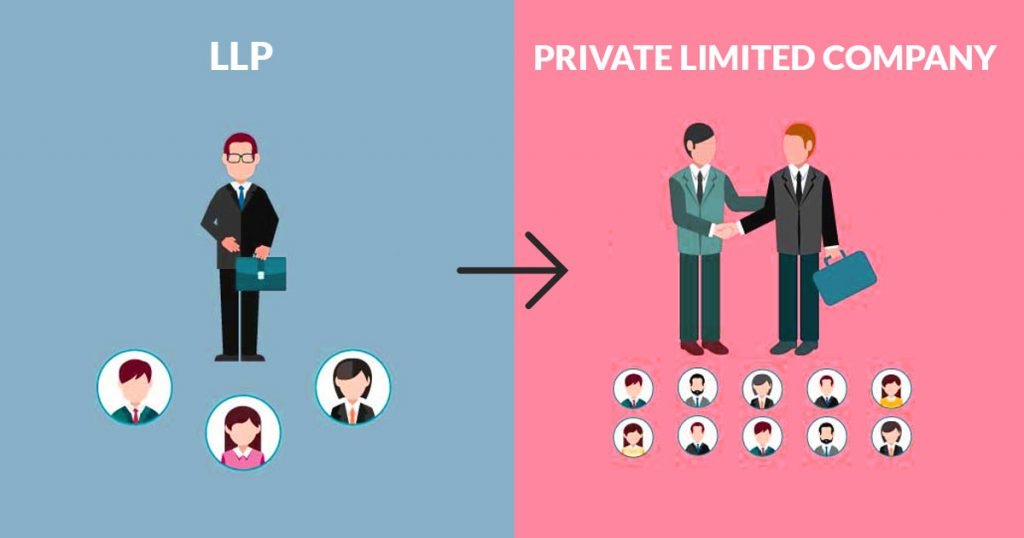
Online Procedure to Convert LLP to PVT. Ltd.
Converting a Limited Liability Partnership (LLP) to a Private Limited Company is a process that involves legal, financial, and procedural steps to transform the business structure from an LLP to a more formalized corporate entity. This transition helps businesses scale, attract investors, and gain enhanced credibility. If your business is looking to expand, raise capital, or enjoy the benefits of a more structured organization, Convert LLP to Private Ltd. could be a strategic move. The process includes meeting legal requirements, filing necessary documentation, and obtaining approvals to ensure compliance with the Companies Act, 2013 or relevant laws.
Many small businesses and startups opt for a Limited Liability Partnership (LLP) due to simpler compliance. However, as the business grows and seeks expansion, converting to a Private Limited Company allows for easier shareholder transfers and access to more capital.
If you’re looking to convert your existing LLP into a Private Limited Company, reach out to Legal Helpzyn. With their expertise, you can rest assured that the entire application and filing process will be handled smoothly and accurately.
Legal Framework for Conversion – Convert LLP to PVT. Ltd.
The process of converting an LLP into a Private Limited Company is governed by the Companies Act, 2013 and the Limited Liability Partnership Act, 2008. In India, the Ministry of Corporate Affairs (MCA) provides the necessary regulations and procedures for such conversions.
Convert LLP to PVT. Ltd. Company with Legal Helpzyn Expert Team
Need Help for Convert LLP to PVT.
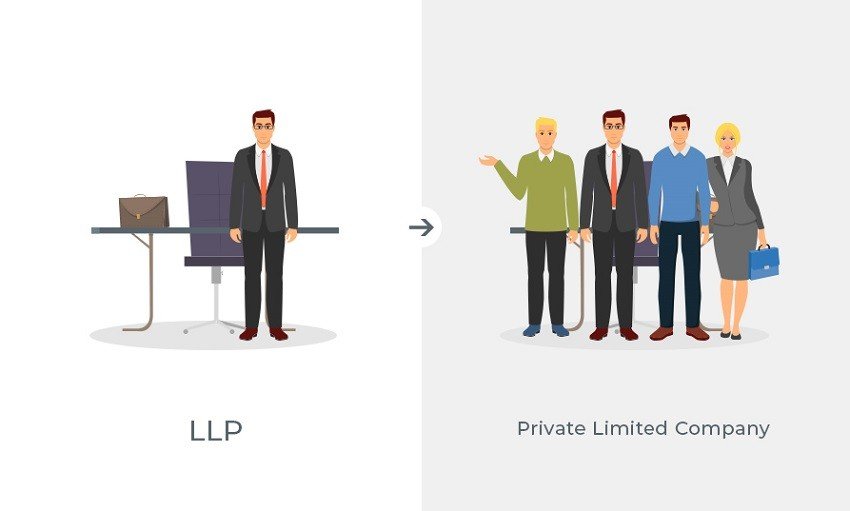
LLP to PVT. Conversion
₹20,000
₹10,000
LLP to Private Limited Company conversion enables easier shareholder transfer and capital growth.
To convert an LLP into a Private Limited Company, certain conditions must be met:
- Minimum Two Partners and Two Shareholders: The LLP must have at least two partners. Similarly, a Private Limited Company requires at least two shareholders.
- No Outstanding Dues: There should be no outstanding liabilities or debts. This ensures that the conversion process is clean and free of encumbrances.
- Active LLP: The LLP should be operational and should not have been struck off or closed.
- Consent from All Partners: All partners must approve the conversion by giving their consent.
- Capital Structure: The capital structure should comply with the norms of a Private Limited Company (e.g., the company must have a minimum paid-up capital, which is generally low but needs to be formally recorded).
- Ability to Raise Capital: A private limited company can issue shares and raise capital more easily than an LLP.
- Attracting Investors: Investors are more comfortable investing in a private limited company as they provide more structure, clear ownership, and legal protections.
- Limited Liability Protection: Both LLPs and Private Limited Companies offer limited liability protection, but a company structure is often seen as more reliable in legal matters.
- Perpetual Succession: Private limited companies have the advantage of perpetual succession (meaning the company can continue indefinitely), which is not always guaranteed with an LLP.
- Tax Benefits: Certain tax incentives or exemptions may be more advantageous for a company over an LLP, depending on the business activity.
- Board Resolution for conversion.
- LLP Agreement and Partnership Deed.
- List of Partners of the LLP.
- Form 18 (Application for conversion).
- MOA and AOA of the proposed Private Limited Company.
- Address Proof of the Registered Office.
- PAN and address proof of all partners.
- Proof of No Objection from creditors (if required).
Convert LLP to PVT. Ltd. – Conversion Process
A Board Resolution needs to be passed by all the partners of the LLP, agreeing to convert the LLP into a Private Limited Company.
- Before applying for the conversion, you need to reserve the name of the new Private Limited Company.
- File a RUN (Reserve Unique Name) application with the Registrar of Companies (RoC) to reserve the name for your company.
A Memorandum of Association (MOA) and Articles of Association (AOA) must be drafted for the proposed company. The MOA outlines the main objectives of the company, while the AOA specifies the rules and regulations for the company’s internal governance.
Form 18 (Application for Conversion of an LLP to a Private Limited Company) needs to be filed with the Registrar of Companies (RoC), along with the following documents:
- Consent of all partners for conversion.
- Board resolution for conversion.
- MOA and AOA.
- Proof of the Registered Office of the LLP.
- List of all partners.
- A copy of the latest partnership deed.
- After the submission of the required forms and documents, the Registrar of Companies (RoC) will process the application.
- If everything is in order, the RoC will approve the conversion and issue a Certificate of Incorporation for the new Private Limited Company.
Once the Registrar approves the conversion, a Certificate of Incorporation will be issued for the newly formed Private Limited Company, which marks the completion of the conversion process.
After conversion, apply for a Permanent Account Number (PAN) and Tax Deduction and Collection Account Number (TAN) for the newly formed company, if not already in place.
Any existing contracts or agreements in the name of the LLP will need to be updated to reflect the name of the new Private Limited Company. Inform clients, vendors, and other stakeholders about the conversion.
Advantages of LLP to Private Limited Company Conversion
- Access to Funding: Easier access to capital through equity financing and loans.
- Corporate Governance: Structured governance as per the Companies Act 2013.
- Expansion and Growth: Better prospects for scaling up the business.
- Brand Credibility: A Private Limited Company carries more weight in the eyes of customers, investors, and financial institutions.
Key Differences Between LLC and Private Limited Company
Feature |
LLP (Limited Liability Partnership) |
Private Limited Company (Pvt Ltd) |
|---|---|---|
How we work

Team Members Assemble Data

Payment Confirmed!

Request Documents From You

Our CA/CS Will Complete the Online Application for You

Awaiting Confirmation from ROC

We Keep Track of Your Application

Success! LLP to Private Limited conversion successfully completed.
Important Considerations
- Capital and Tax Structure: You need to decide whether you want to raise capital through share issuance after conversion. Also, note that the tax structure for a company may be different from an LLP, and you may need professional advice to understand the implications.
- Transition of Assets and Liabilities: The assets and liabilities of the LLP automatically get transferred to the Private Limited Company after the conversion process. However, legal formalities may be required to notify creditors, vendors, and clients.
- Registrar of Companies (RoC): All filings and approvals will be done through the RoC. The process can take several weeks, depending on the completeness of your application.
Frequently Asked Questions (FAQs)
1. What is the process to convert an LLP into a Private Limited Company?
The process to convert an LLP into a Private Limited Company involves several steps:
- Passing a board resolution by the LLP partners.
- Reserving the company name with the Registrar of Companies (RoC).
- Preparing and filing the necessary documents (MOA, AOA, Form 18, etc.) with the RoC.
- Obtaining approval from the RoC, followed by the issuance of a Certificate of Incorporation for the new Private Limited Company.
- Updating all existing contracts and agreements to reflect the new company structure.
2. What documents are required for converting an LLP to a Private Limited Company?
The essential documents required include:
- Board resolution for conversion.
- LLP agreement and list of partners.
- Address proof of the LLP’s registered office.
- MOA and AOA for the proposed Private Limited Company.
- PAN and address proof of partners.
- Form 18 (application for conversion).
- NOC from creditors (if necessary).
3. What are the eligibility criteria for converting an LLP to a Private Limited Company?
The main criteria for conversion are:
- The LLP must have at least two partners and must not be struck off.
- There should be no outstanding liabilities or debts.
- All partners should consent to the conversion.
- The LLP should be operational and compliant with relevant regulations.
4. Is there a minimum paid-up capital requirement for a Private Limited Company?
There is no mandatory minimum capital requirement for a Private Limited Company, but it must have authorized capital (e.g., ₹1 lakh or more). The capital structure will be defined in the MOA and AOA.
5. How long does the conversion process take?
The entire process typically takes between 1 to 3 months, depending on the completeness of the documents, approval time from the Registrar of Companies (RoC), and any additional queries or corrections that may arise.
6. Can the LLP's assets and liabilities be transferred to the new Private Limited Company?
Yes, once the conversion is approved, all assets and liabilities of the LLP are automatically transferred to the Private Limited Company. However, certain formalities may need to be completed with creditors and vendors.
7. Do I need to file for a new PAN and TAN after conversion?
Yes, the Private Limited Company will need to apply for a new Permanent Account Number (PAN) and Tax Deduction and Collection Account Number (TAN) after conversion, if not already obtained.
8. Can an LLP convert to a Private Limited Company anytime?
Yes, as long as the LLP fulfills the eligibility conditions (operational, no debts, and all partners’ consent), it can convert to a Private Limited Company. However, conversion may not be possible if the LLP has been struck off or has pending legal disputes.
9. What are the advantages of converting an LLP into a Private Limited Company?
The key benefits include:
- Easier access to capital and funding.
- Better prospects for attracting investors.
- Structured corporate governance.
- Increased credibility in the business world.
- Perpetual succession for the company.
10. What are the disadvantages or challenges of conversion?
Some challenges include:
- The conversion process involves legal and procedural complexities.
- There may be higher compliance costs and regulatory requirements for Private Limited Companies.
- The company structure may have higher tax implications than an LLP.
11. Will I need a professional to help with the conversion?
Yes, it is recommended to consult a Company Secretary, Chartered Accountant, or a legal professional to guide you through the legal and procedural requirements for the conversion, ensuring smooth filing and compliance with regulatory standards.
12. What happens to the existing contracts and agreements of the LLP after conversion?
After conversion, the name and structure of the business will change. Existing contracts and agreements will need to be updated to reflect the new Private Limited Company’s name. You should notify clients, vendors, and stakeholders about the transition.
13. How much does it cost to convert an LLP to a Private Limited Company?
The conversion cost includes:
- Government fees for filing forms and documents with the RoC.
- Professional fees for assistance with the legal and filing process.
- Miscellaneous costs for updating contracts, PAN, and other documents. The overall cost varies depending on the service provider and complexity of the conversion.