

About Public Limited Company
A Public Limited Company (PLC) is a company whose shares are available for purchase by the public on the open market through a stock exchange. It is a separate legal entity with limited liability, meaning the owners (shareholders) are not personally liable for the company’s debts beyond their investment in the company’s shares.
Set up Public Limited Company with Legal Helpzyn
Need Help for Public Limited Company

Public Limited Company
₹36000
₹18000
A public limited company (PLC) is a company with publicly traded shares and limited liability for shareholders.
Benefits of a Public Limited Company
Access to Capital: PLCs can raise large amounts of capital by issuing shares or bonds. This capital can be used for expansion, acquisitions, or paying down debt.
Liquidity: The shares of a PLC are generally highly liquid because they are traded on the stock exchange. Shareholders can easily buy and sell shares, providing flexibility and opportunity for investment.
Reputation and Visibility: Being listed on a stock exchange can enhance a company’s reputation and public profile. It also increases visibility to potential customers, suppliers, and investors.
Employee Stock Options: PLCs often offer stock-based compensation (such as stock options) to attract and retain talented employees.
Operational Aspects of Public Limited Compay
Formation: Requires a formal registration process, including the submission of articles of association and compliance with local laws.
Annual General Meetings (AGMs): Required to hold AGMs where shareholders can vote on key issues and elect directors.
Financial Reporting: Must prepare and publish detailed financial reports, including balance sheets, income statements, and cash flow statements.
Shareholder Rights: Shareholders have rights to dividends, voting, and information about the company.
Takeovers and Mergers: More susceptible to takeovers since shares are publicly traded, allowing other companies or investors to acquire control.
Requirements for Registration of a Public Limited Company in India
Choose a Company Name: Must be unique and include “Public Limited Company” or “PLC” or “Ltd”.
Obtain Digital Signature Certificate (DSC): Required for all proposed directors and shareholders for electronic filings.
Obtain Director Identification Number (DIN): Each proposed director must apply for a DIN.
Draft Memorandum and Articles of Association:
- Memorandum of Association (MoA): Outlines company objectives and structure.
- Articles of Association (AoA): Governs internal management.
Minimum Share Capital: Minimum paid-up capital of ₹5,000,000 (5 million INR).
Registered Office: Must have a registered office address in India.
File Incorporation Documents: Submit Form SPICe, MoA, AoA, proof of registered office, and identity/address proof of directors and shareholders to the Registrar of Companies (ROC).
Payment of Fees: Pay the prescribed registration fees.
Certificate of Incorporation : ROC issues this upon verification of documents.
Commencement of Business: Obtain a Certificate of Commencement of Business within 180 days of incorporation.
Compliance with Securities Regulations: If offering shares to the public, comply with SEBI regulations.
Ongoing Compliance: Adhere to annual compliance requirements, including filing annual returns and holding AGMs.
What is IPO ?
An IPO (Initial Public Offering) is when a private company offers its shares to the public for the first time, becoming a public limited company. Through an IPO, the company raises capital by selling shares on a stock exchange. It allows the company to access more funding, increase its visibility, and provide liquidity for shareholders. However, it also involves regulatory scrutiny, high costs, and potential loss of control for the company’s founders.
Advantages of an IPO for a PLC
- Access to Capital: An IPO can provide substantial capital for growth and expansion.
- Market Presence: Being publicly traded can enhance the company’s market presence and attract new customers and business partners.
- Employee Incentives: Public companies can offer stock options or shares as part of employee compensation, which can help attract and retain talent.
Documents Required for Registration of a Public Limited Company

- Memorandum of Association (MoA): Outlines objectives and structure.
- Articles of Association (AoA): Governs internal management.
- Form SPICe: Application for incorporation.
- Proof of Registered Office: Utility bill or rental agreement with NOC.
- Identity Proof of Directors: Aadhar card, passport, etc.
- Address Proof of Directors: Utility bill or bank statement.
- Director Identification Number (DIN): Application form with ID and address proof.
- Digital Signature Certificate (DSC): For electronic filings.
- Affidavit from Directors: Declaration of compliance with the Companies Act.
- List of Shareholders: Details of initial shareholders and shares held.
Procedure for Registration of a Public Limited Company
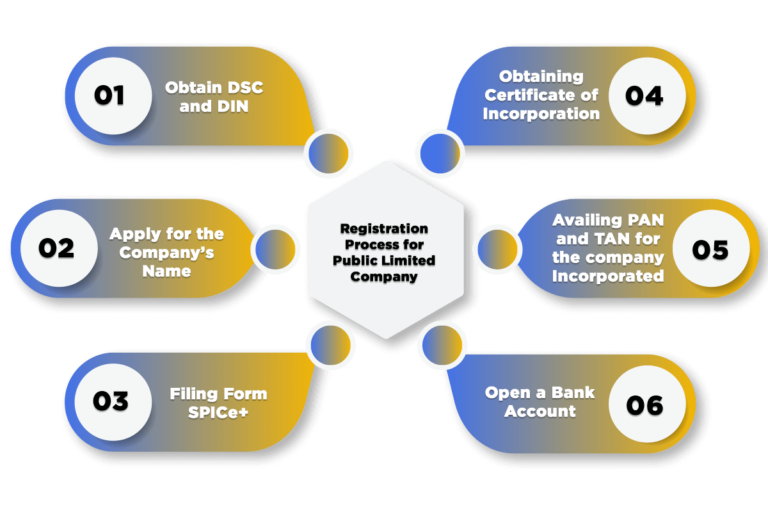
Obtain DSC and DIN
A Digital Signature Certificate (DSC) is required for filing e-forms with the Ministry of Corporate Affairs (MCA). DIN (Director Identification Number) is required for all individuals who wish to be directors in the company.
Apply for the company’s name
This is the first step in the company registration process. You need to submit an application to the MCA with the proposed name of the company.
Filing Form SPICE+
This form contains all the information required for registering a public limited company. This includes details about the company’s name, address, directors, share capital, etc.Obtaining Certificate of Incorporation
Once the MCA approves the application, it will issue a certificate of incorporation. This document confirms that the company is legally registered.Availing PAN and TAN for the company incorporated
PAN (Permanent Account Number) and TAN (Tax Deduction and Collection Account Number) are mandatory for all companies in India.Open a Bank Accoun
Once the company is registered, you need to open a bank account in the name of the company. This will be used for all financial transactions of the company.Private Limited Company vs. Public Limited Company
Feature |
Private Limited Company |
Public Limited Company |
|---|---|---|
Frequently Asked Questions (FAQs)
How is a Public Limited Company(PLC) different from a private limited company?
The main differences are:
- Share Availability: A PLC can sell shares to the public, while a private limited company (Ltd) cannot.
- Regulatory Requirements: PLCs are subject to stricter regulatory requirements and must disclose more financial information than private companies.
What are the advantages of becoming a PLC?
- Access to Capital: PLCs can raise funds by issuing shares to the public.
- Enhanced Credibility: Being publicly traded can enhance the company’s reputation and credibility.
- Liquidity for Shareholders: Shares can be bought and sold on the stock exchange, providing liquidity for investors.
What are the disadvantages of being a Public Limited Company(PLC)?
- Regulatory Scrutiny: PLCs face more stringent regulations and reporting requirements.
- Cost: The costs associated with becoming and remaining a PLC can be high (e.g., legal fees, listing fees).
- Loss of Control: Founders may lose some control over the company as more shareholders come on board.
What are the requirements to become a PLC?
Requirements can vary by country but generally include:
- Minimum number of shareholders.
- A minimum share capital requirement.
- Compliance with regulatory standards and listing requirements of the stock exchange.
How does a company go public?
A company typically goes public through an Initial Public Offering (IPO), where it offers shares to the public for the first time. This process usually involves underwriting by investment banks, regulatory filings, and marketing the shares to potential investors.
What are the ongoing obligations of a Public Limited Company(PLC)?
PLCs must:
- File regular financial reports (quarterly and annually).
- Disclose material information that could affect share price.
- Hold annual general meetings (AGMs) and provide shareholders with voting rights.
What is a stock exchange?
A stock exchange is a marketplace where shares of publicly traded companies are bought and sold. Examples include the New York Stock Exchange (NYSE) and the London Stock Exchange (LSE).
What is the role of a board of directors in a PLC?
The board of directors is responsible for overseeing the company’s management, making strategic decisions, and ensuring that the company adheres to legal and ethical standards.
Can anyone invest in a PLC?
Yes, anyone can invest in a PLC as long as they have access to the stock market through a brokerage account.
What is a dividend?
A dividend is a portion of a company’s earnings distributed to shareholders. PLCs may pay dividends to their shareholders as a reward for investing in the company.
How can I find information about a PLC?
Information about a PLC can typically be found in its annual reports, regulatory filings, and through financial news websites. Additionally, stock exchanges provide data on publicly traded companies.
What happens if a PLC performs poorly?
If a PLC performs poorly, its share price may decline, leading to a loss in shareholder value. In severe cases, the company may face bankruptcy or delisting from the stock exchange.
What is an Initial Public Offering (IPO)?
An IPO is the process by which a private company offers its shares to the public for the first time, transitioning into a public limited company.
Can a PLC be taken private?
Yes, a PLC can be taken private through a process known as “going private,” where a private equity firm or a group of investors buys out the public shareholders.