

Change Company Name In India
Changing a company’s name is a significant decision that involves a legal process and a series of steps to ensure that the name change is properly registered and communicated. The exact procedure will depend on the country and legal structure of your business (e.g., corporation, LLC, sole proprietorship), but here’s a comprehensive guide to changing a company name.
Change/Modify Company Name with Legal Helpzyn Expert
Need Help for Modify Company Name

Change Company Name
₹16000
₹8000
Changing a company name involves rebranding the business to reflect a new identity, vision, or market focus.
Businesses may choose to change their name for several reasons:
- Rebranding: To refresh the company's image or align the name with a new marketing strategy.
- Mergers or Acquisitions: When one company merges with or acquires another, the name may change to reflect the new ownership structure.
- Expansion or Diversification: A name change may reflect the company’s expansion into new markets, industries, or product lines.
- Legal or Regulatory Reasons: If the current name conflicts with trademarks, other businesses, or regulatory requirements.
- Negative Associations: If the business is experiencing negative press or public relations issues tied to the current name.
- Cultural or Global Considerations: When a company goes global and needs a name that resonates in different languages and markets.
A company is eligible to change its name if it meets the following conditions:
Board & Shareholder Approval: The company must pass a resolution in the Board meeting and a special resolution by shareholders at an Extraordinary General Meeting (EGM) to approve the name change.
No Pending Legal Issues: The company should not have any ongoing litigation or disputes related to its current name, as it could complicate the name change process.
Compliance with Name Guidelines: The new name must comply with the guidelines set by the Ministry of Corporate Affairs (MCA). It should not be identical or similar to an existing company or trademark. It must also not violate any laws or regulations.
Active Status: The company must be active and in good standing with the Registrar of Companies (RoC), meaning it has filed its annual returns and financial statements on time.
Clearance of Pending Fees: The company should clear any pending fees, penalties, or other dues with the RoC before applying for the name change.
Changing a company name in India can offer several benefits, including:
- Rebranding and Market Expansion: A new name can help reposition the company to appeal to a broader or different customer base, especially when entering new markets or launching new products.
- Alignment with Business Vision: The new name can better align with the company's evolving mission, vision, and values, reflecting its growth or strategic shifts.
- Improved Brand Image: A fresh name can help overcome any negative associations with the old name, enhancing reputation and attracting positive attention.
- Legal Compliance: A name change may be necessary to avoid trademark conflicts or to comply with legal or regulatory requirements.
- Global Reach: A more internationally friendly or culturally neutral name can facilitate global expansion and improve brand recognition abroad.
- Increased Investor Confidence: A name change may reflect a revitalized corporate structure or leadership, boosting investor confidence and attracting potential partners.
Documents required for changing company name
Changing a company name in India involves several legal and procedural steps.
- Board Resolution :- A resolution passed by the company’s Board of Directors approving the proposed name change.
- Shareholder’s Special Resolution :-A special resolution passed by the shareholders at the General Meeting (EGM or AGM), approving the name change.
- Form MGT-14 :- This form is required to be filed with the Registrar of Companies (RoC) within 30 days of passing the special resolution. It is used for filing the resolution passed by the Board and shareholders.
- Form INC-1 (Name Reservation Application) :- Application to reserve the new company name. You must submit a request for the proposed name via this form to the Ministry of Corporate Affairs (MCA).
- Updated Memorandum of Association (MOA) :- The MOA should be updated with the new name of the company. It needs to be filed with the RoC as part of the name change process.
- Updated Articles of Association (AOA) :- The AOA must be updated to reflect the new name and submitted along with the application to the RoC.
- Certificate of Incorporation (COI) :- A copy of the company’s current Certificate of Incorporation issued by the RoC.
- Digital Signature Certificate (DSC) :- The digital signature of the company’s authorized representative or director for filing documents online with MCA.
- PAN and TAN Card (if applicable) :- The company’s PAN and TAN details may need to be updated with the new name after approval from RoC.
- Affidavit from Directors (if required) :- In some cases, the company may be asked to submit an affidavit confirming the name change decision.
- Additional Documents (if required) :- Depending on the nature of the company (private, public, etc.), additional documents such as a No Objection Certificate (NOC) from lenders, partners, or any other stakeholders may be required.
Step for Changing Company Name
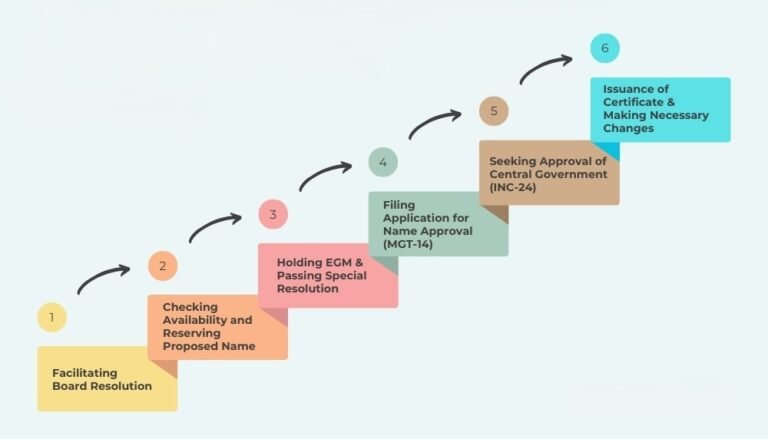
Facilitating Board Resolution
The first step is for the promoters of the company to pass a board resolution that authorizes the company to incorporate. This resolution should include the proposed name of the company and the authorized share capital.
Checking Availability and Reserving Proposed Name
The promoters need to check the availability of the proposed name of the company with the Registrar of Companies (RoC). If the name is available, they can reserve the name by filing a Form INC-1.Holding EGM & Passing Special Resolution
After reserving the name, the promoters need to hold an Extraordinary General Meeting (EGM) of the company to pass a special resolution that approves the memorandum and articles of association (MoA and AoA) of the company.Filing Application for Name Approval
The promoters need to file an application for name approval with the RoC in Form INC-1.Seeking Approval of Central Government (INC-24)
After the RoC approves the name of the company, the promoters may need to seek approval from the Central Government for the company’s name if the company is engaged in certain specified activities.Issuance of Certificate & Making Necessary Changes
Once the RoC receives all the necessary documents and approvals, it will issue the Certificate of Incorporation.Timeline for Changing a Company Name
The timeline for changing your company name can vary based on several factors:
- Filing with the appropriate government agency can take anywhere from a few days to several weeks, depending on the jurisdiction and the complexity of the application.
- Updating records and communicating with stakeholders (clients, vendors, etc.) can take several weeks to months.
- Rebranding efforts (new logos, marketing materials, websites, etc.) can take additional time and effort, particularly for larger businesses.
Frequently Asked Questions (FAQs)
1. Why would a company change its name?
Companies may change their name to reflect a new business strategy, rebranding efforts, expansion into new markets, or to resolve trademark issues.
2. What is the process to change a company name in India?
The process involves obtaining board and shareholder approval, reserving the new name with the Registrar of Companies (RoC), updating the company’s Memorandum and Articles of Association (MOA & AOA), and filing the necessary forms (e.g., MGT-14, INC-1) with the RoC.
3. Can a company change its name without shareholder approval?
No, shareholder approval is essential. The process requires a special resolution passed by shareholders at an Extraordinary General Meeting (EGM). This means that at least two-thirds of the shareholders present and voting must agree to the name change. Without this approval, the name change cannot be processed by the Registrar of Companies.
4. Can a company choose any name it wants?
No, the proposed company name must comply with the Ministry of Corporate Affairs (MCA) guidelines. The new name:
- Should not be identical or similar to an existing company or trademark.
- Must not contain words that are prohibited under Indian laws, such as names that suggest a government affiliation or violate public policy.
- Should not be misleading or offensive.
- Must be available for registration with the RoC.
5. How long does it take to change a company name in India?
The process typically takes about 1-2 weeks, depending on the complexity of the case and the workload of the Registrar of Companies. However, if the name reservation is delayed or if there are issues with the documentation, the process could take longer. After filing the necessary forms, the RoC will review the application, and once the name is approved, a new Certificate of Incorporation will be issued.
6. Will the company’s legal identity change with the name?
No, the company’s legal identity, registration number (CIN), and tax identification details remain the same after the name change. Only the name of the company is updated. The company continues to exist with its original legal obligations, liabilities, and structure, and there is no need to form a new legal entity. The name change only affects the branding and legal identity used in official documents, contracts, and communications.
7. Do I need to update the company’s PAN and TAN after a name change?
Yes, after the name change is approved by the RoC, the company will need to update its PAN and TAN with the Income Tax Department. The name on these documents must match the company’s new name. However, the PAN and TAN number itself remains the same, and the company will only need to request an update to reflect the new name.
8. Can the name change be rejected by the RoC?
Yes, the RoC may reject the name change application for several reasons:
- If the proposed name conflicts with an existing registered company name or trademark.
- If the name does not comply with MCA’s naming guidelines.
- If the company has unresolved legal issues or pending compliance filings.
To avoid rejection, it’s important to conduct a thorough search to ensure the name is unique and does not violate any rules before submitting the application.
9. What is the cost involved in changing a company name?
The cost of changing a company name can vary depending on several factors:
- Filing Fees: The filing fees for forms like MGT-14 and INC-1 vary based on the company type (Private or Public).
- Professional Fees: If you engage a professional (like a chartered accountant, company secretary, or lawyer) to help with the process, there will be additional service charges.
- Administrative Costs: If the company needs to update documents like PAN, TAN, or signage, there may be additional costs involved.
10. Can a public company change its name?
Yes, public companies can change their name following the same procedure as private companies. However, public companies may have more stringent requirements for shareholder approval, especially if the name change involves significant changes to the business structure or branding. Additional compliance may also be required, such as informing regulatory bodies or investors.
11. Will changing the company name affect existing contracts and agreements?
Changing the company name does not affect the validity of existing contracts, agreements, or obligations, as the company’s legal identity remains the same. However, it is advisable to notify clients, suppliers, business partners, and other stakeholders about the name change to avoid confusion and ensure that documents reflect the updated name.
12. Do I need a new certificate of incorporation after the name change?
Yes, once the name change is approved by the RoC, the company will receive a new Certificate of Incorporation with the updated name. This serves as the official document confirming the company’s new name. The previous certificate becomes invalid after the name change, and all future legal documents, contracts, and filings should reflect the new name.