

About Section 8 Company
A Section 8 company is a type of company in India that is formed for charitable, social, educational, religious, scientific, cultural, or similar purposes. It is registered under Section 8 of the Companies Act, 2013, which regulates the establishment of non-profit organizations. Section 8 companies are similar to Non-Governmental Organizations (NGOs), but they follow the structure and legal framework of a company rather than a trust or society.
key features:
Purpose: Established for promoting social welfare, education, art, science, charity, or other useful objectives for the public good.
Profit Distribution: Profits cannot be distributed to members; they must be reinvested in the company’s objectives.
Incorporation: Requires a license from the Central Government and can be registered as a private or public limited company.
Directors: Minimum of two directors for a private company and seven for a public company.
Name: Must include terms like “Foundation,” “Trust,” “Society,” or “Institute.”
Compliance: Subject to regulatory requirements, including annual filings with the Registrar of Companies (ROC).
Tax Benefits: Eligible for tax exemptions under the Income Tax Act, 1961, if conditions are met.
Set up Section 8 company with Legal Helpzyn
Need Help for Section 8 company

Section 8 Company
₹24000
₹12000
A Section 8 Company in India is a non-profit focused on social welfare and cannot distribute profits.
- Non-Profit Status: Focus on social welfare without profit distribution.
- Tax Exemptions: Eligible for various tax benefits under the Income Tax Act.
- Limited Liability: Protects members from personal liability for the company’s debts.
- Credibility: Enhances trust and credibility among donors and stakeholders.
- Access to Funding: Can receive grants and donations from government and private entities.
- No Minimum Capital Requirement: Flexibility in capital structure.
- Perpetual Succession: Continues to exist independently of changes in membership.
Name Approval: Choose a unique name and apply for approval.
Documents Required: Prepare necessary documents, including the Memorandum of Association (MoA) and Articles of Association (AoA).
Filing with ROC: Submit the application to the Registrar of Companies (ROC) along with the required fees.
Certificate of Incorporation: Upon approval, the company receives a Certificate of Incorporation.
To register a Section 8 company, you will need to prepare and submit several key documents. Here’s a comprehensive list of the required documents:
Memorandum of Association (MoA): This should be prepared in Form INC 13, outlining the company's objectives.
** Articles of Association (AoA)**: This document defines the rules and regulations governing the company.
Declaration in INC 14: A declaration must be made by a Company Secretary (CS), Chartered Accountant (CA), or Cost Accountant (CWA) in practice.
Identity Proof: Self-attested copies of identity proof for all directors and members, such as:
- PAN card
- Passport
- Voter ID
- Aadhar card
Address Proof: Documents verifying the registered office address, which may include:
- Utility bills
- Rental agreement
- Property ownership documents
Digital Signature Certificate (DSC): Required for the directors to sign the electronic forms.
Passport Size Photographs: Recent photographs of all directors and members.
Proof of Residential Address: Self-attested copies of documents confirming the residential address of all directors and members.
NOC from the Owner: If the registered office is not owned by the company, a No Objection Certificate (NOC) from the property owner is necessary.
Self-Declaration: A declaration stating that the company will not be formed for profit-making purposes.
Other Supporting Documents: Any additional documents that may be required based on specific circumstances or state regulations.
Section 8 Company Registration Eligibility
To register a Section 8 company in India, which is a non-profit organization, the following eligibility criteria must be met:
Non-Profit Objective: The company must be formed for charitable purposes such as education, health, social welfare, environment, etc. Profits cannot be distributed to members.
Minimum Members: A minimum of two directors and two shareholders are required.
No Minimum Capital: There is no minimum capital requirement, but the company must have sufficient funds for its objectives.
Approval from MCA: Before registration, approval must be obtained from the Ministry of Corporate Affairs (MCA). The company must submit a detailed plan and receive a license.
Directors: Directors should have a clean legal record and at least one must be a resident of India.
Documents Required: Include Memorandum of Association (MOA), Articles of Association (AOA), and identity/address proof of directors and members.
Tax Exemption: Section 8 companies may be eligible for tax exemptions under Section 12A and 80G of the Income Tax Act if they meet specific requirements.
Registration Process of Section 8 company
Obtain Digital Signature Certificate (DSC): Required for proposed directors.
Apply for Director Identification Number (DIN): File Form DIR-3 with identity and address proof.
Draft MoA and AoA: Outline the company’s charitable objectives and internal rules.
File Form INC-12: Apply for a license with MoA, AoA, and other required documents.
Obtain License: The Ministry of Corporate Affairs reviews and issues a license.
Register with RoC: File Forms INC-7, DIR-12, and INC-22 along with the license and required documents.
Receive Certificate of Incorporation: Officially register your Section 8 Company.
Required Documents for Registration
- MoA and AoA: Clearly stating the objectives and rules of the company.
- Proof of Address: For the registered office of the company.
- Identity and Address Proof: For all directors.
- Declaration by Directors: Confirming compliance with the requirements of the Companies Act.
Purposes of Section 8 Company
Promotion of Education: Establishing educational institutions, training centers, or scholarships.
Social Welfare: Working for the upliftment of marginalized communities, providing healthcare, or supporting social causes.
Arts and Culture: Promoting arts, culture, heritage, and crafts through various initiatives and programs.
Science and Research: Conducting research, development, and awareness programs in scientific fields.
Sports: Promoting sports and athletic activities, organizing events, and supporting athletes.
Environmental Protection: Engaging in activities related to environmental conservation and awareness.
Other Charitable Objectives: Any other purpose that benefits the public at large and aligns with the non-profit motive.

Section 8 Company Incorporation Requirement

Non-Profit Objective: The company must be formed for charitable purposes (e.g., education, health, welfare) and cannot distribute profits to members.
Minimum Members: At least two directors and two shareholders are required.
MCA Approval: Prior approval from the Ministry of Corporate Affairs (MCA) is needed for registration.
Directors: A minimum of two directors, with one being a resident of India.
Documents: MOA and AOA, along with identity/address proof of directors and shareholders.
No Minimum Capital: No capital requirement, but enough funds to fulfill the company’s objectives.
Tax Exemption: Eligibility for tax benefits under Sections 12A and 80G, if applicable.
Company Name: Must reflect the non-profit nature (e.g., “Foundation” or “Trust”).
How do you register as a Section 8 company?
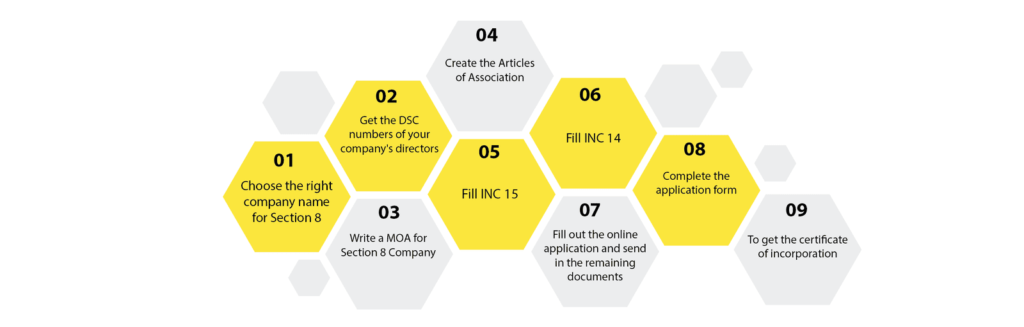
1. Choose the right company name for Section 8
- This step is crucial because your company’s name must be unique and relevant to your business.
- It must meet certain requirements set by the Ministry of Corporate Affairs.
- You can check for availability of the desired name online through the MCA website.
2. Get the DSC numbers of your company’s directors
- A Digital Signature Certificate (DSC) is a mandatory requirement for filing forms and documents with the MCA.
- Each director of the company needs a DSC for authentication purposes.
- You can obtain a DSC from a licensed certifying authority.
3. Write a MOA for Section 8 Company
- The Memorandum of Association (MOA) is a legal document that defines the company’s objectives, powers, and limitations.
- It states the purpose of the company and the nature of its business.
- For a Section 8 company, the MOA must clearly specify the charitable and non-profit objectives.
4. Create the Articles of Association
- The Articles of Association (AOA) are the rules and regulations that govern the internal management of the company.
- It outlines the rights, responsibilities, and procedures of the company’s members, directors, and employees.
5. Fill INC 15
- INC 15 is an online application form that is required for incorporating a Section 8 company.
- It includes details about the company’s name, registered office, and other relevant information.
6. Fill INC 14
- INC 14 is an online form that needs to be filled out and submitted to the MCA.
- It is used to confirm the availability of the chosen company name.
7. Fill out the online application and send in the remaining documents
- This step involves submitting all the required documents, including the MOA, AOA, and other supporting documents, to the MCA through the online portal.
8. Complete the application form
- The online application form must be completed accurately and submitted to the MCA.
- You must provide all the necessary information, including the company’s details, directors’ details, and other relevant information.
9. To get the certificate of incorporation
After the verification and approval, the MCA will issue a Certificate of Incorporation. This certificate confirms that the company is officially registered.
Frequently Asked Questions(FAQs)
A Section 8 Company is a type of non-profit organization registered under the Companies Act, 2013, which aims to promote social welfare, education, charity, or other beneficial objectives without the intention of making profits.
- Non-Profit Objective: The main objective must be to promote social welfare, education, etc.
- No Profit Distribution: Profits cannot be distributed to members; they must be reinvested in the company’s objectives.
- Limited Liability: Members have limited liability, protecting personal assets.
- Minimum Members: Requires a minimum of two members to register.
- No Minimum Capital Requirement: There is no minimum capital requirement for registration.
- Obtain a Digital Signature Certificate (DSC) for the proposed directors.
- Apply for a Director Identification Number (DIN).
- Draft the Memorandum of Association (MoA) and Articles of Association (AoA).
- File Form INC-12 with the Registrar of Companies (RoC) along with required documents.
- Obtain a license from the Central Government to operate as a Section 8 Company.
- MoA and AoA.
- Proof of address of the registered office.
- Identity and address proof of the directors.
- A declaration by the directors regarding compliance with the requirements.
Yes, a Section 8 Company can earn profits, but these profits must be utilized for the promotion of its objectives and cannot be distributed among its members.
- Annual filing of financial statements with the RoC.
- Maintenance of proper books of accounts.
- Conducting annual general meetings (AGMs).
- Compliance with tax regulations, including obtaining a PAN and filing income tax returns.
Yes, Section 8 Companies can apply for tax exemptions under Section 80G of the Income Tax Act, provided they meet the necessary criteria.
Yes, a Section 8 Company can convert to a regular company by following the prescribed procedure under the Companies Act, 2013, which includes obtaining approval from the Central Government.
The Board of Directors is responsible for the governance and management of the company, ensuring that it operates in accordance with its objectives and complies with legal requirements.
Non-compliance can lead to penalties, fines, or even the winding up of the company. It is essential to adhere to the regulations set forth in the Companies Act, 2013.